
Table of Contents
Pink Curing Salt: The Complete USA Guide to Curing Salt 1 (Prague Powder)
If you’ve ever wondered why home-cured bacon, corned beef, or sausage stays that appetizing pink color instead of turning gray, the answer is pink curing salt. This guide breaks down everything American home cooks and small-batch meat curers need to know — from what curing salt actually is, to how curing salt 1 (Prague Powder) keeps food safe, to exactly where to buy it in the USA.
At Himalyan Pink Salt, one question customers frequently raise is whether pink curing salt is the same as natural Himalayan pink salt. It isn’t, and understanding the difference matters before your next batch of homemade sausage or corned beef. As a supplier that ships wholesale Himalayan pink salt in bulk across the USA, we regularly field this exact question from retailers and home cooks alike.
What Is Curing Salt?
Curing salt is a specially formulated salt blend that preserves meat and prevents harmful bacteria, particularly Clostridium botulinum, from growing and causing botulism. Unlike regular table salt, curing salt contains a small, carefully measured percentage of sodium nitrite (and sometimes sodium nitrate), which is what gives cured meats their signature flavor, texture, and rosy color.
It’s worth noting that curing salt is a manufactured, chemical-based product — a distinct category from natural rock salt. If you’re curious how naturally mined salt differs, our post on whether rock salt is edible explains how unrefined salt behaves differently in food applications compared to processed cures.
Pink Curing Salt Explained
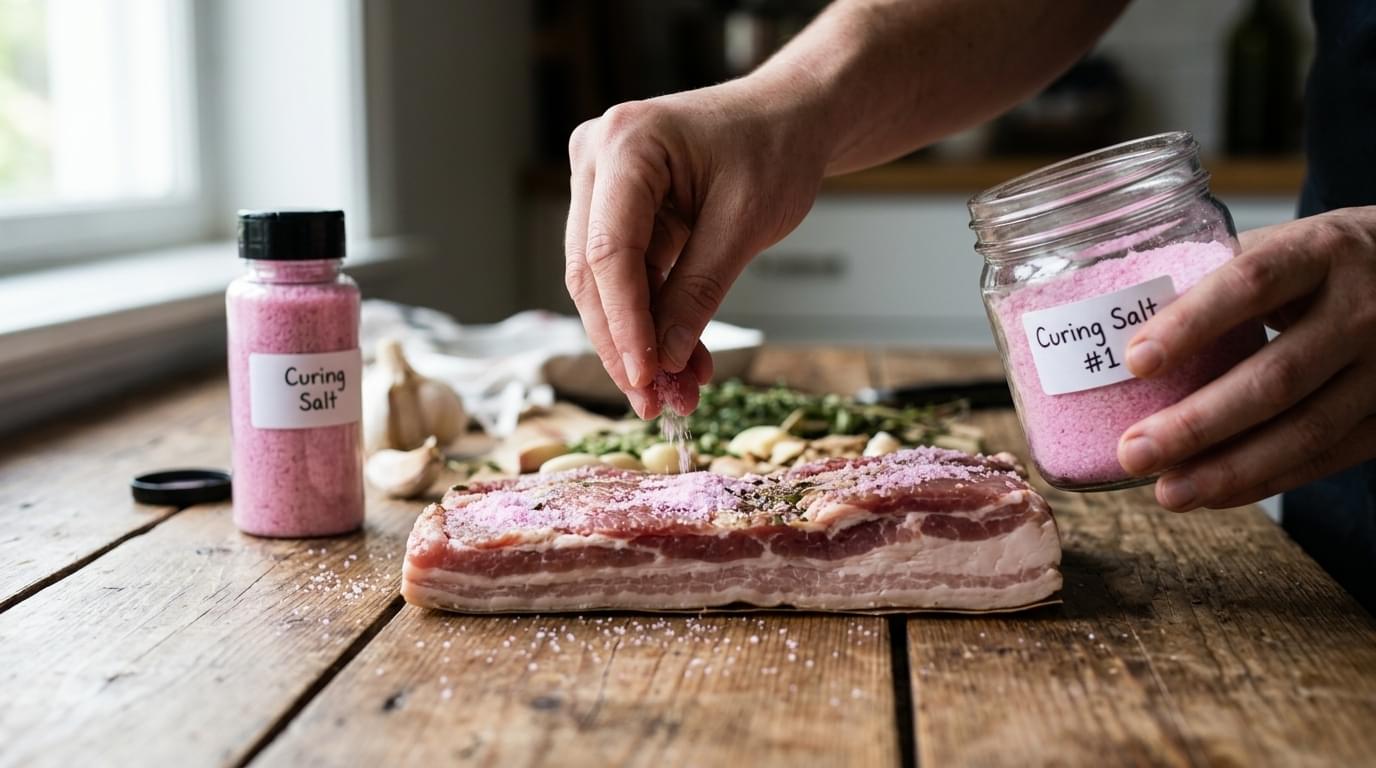
Pink curing salt gets its color from a dye added during manufacturing — not from any pink mineral content. This artificial pink tint exists for one critical reason: to distinguish it from regular table salt so nobody accidentally mistakes a highly concentrated cure for everyday seasoning. Ingesting curing salt in table-salt-sized quantities can be dangerous, so the pink dye acts as a visual safety warning.
This is the biggest point of confusion for customers browsing our fine Himalayan pink salt for everyday cooking. Our salt gets its pink hue naturally from trace minerals in the Khewra Salt Range. In contrast, pink curing salt is a manufactured preservative blend dyed for safety.
Our guide to authentic Himalayan salt covers how to verify you’re buying the real, unrefined mineral product. Both salts are pink, but their purpose and composition are completely different.
Curing Salt 1 (Prague Powder #1): What It Really Is
When American recipes mention “curing salt 1,” “Prague powder,” or “pink cure salt,” they’re almost always referring to the same product: a mix of approximately 93.75% regular salt and 6.25% sodium nitrite. This is the standard for short-term cures — think bacon, ham, hot dogs, and other meats that will be cooked before eating.
There’s also a Prague Powder #2, which includes sodium nitrate in addition to nitrite, designed for dry-cured products like salami or prosciutto that cure for weeks or months without cooking. Using the wrong type for the wrong recipe is one of the most common, and riskiest, mistakes new curers make. Always confirm the label before buying, the same way you’d check product specifications on any Himalayan pink salt product before ordering.
How Salt Meat Curing Actually Works
Salt meat preservation isn’t new — it’s one of the oldest food preservation methods in human history. Salt draws moisture out of meat through osmosis, creating an environment where spoilage bacteria struggle to survive. Curing salt builds on this ancient method by adding nitrites, which specifically target botulism-causing bacteria while also stabilizing color and enhancing flavor.
Coarser salt grains are often preferred for dry-rub style curing because they dissolve more slowly and distribute more evenly across a cut of meat. Our coarse Himalayan pink salt is a popular choice among home cooks for general seasoning once the curing process is complete, though it should never replace a nitrite-based curing salt during the actual cure.
Pink Salt Cure for Corned Beef
Corned beef is one of the most popular home-curing projects in the USA, especially around St. Patrick’s Day. A pink salt cure for corned beef typically involves submerging a beef brisket in a brine made of water, salt, sugar, pickling spices, and curing salt 1 for 5–10 days in the refrigerator.
Nitrite gives traditional corned beef its distinctive pink-red hue after cooking. Without it, the brisket would turn dull gray-brown, like a standard pot roast.
After curing and cooking, many home cooks finish the dish with natural, mineral-rich salt. Our extra fine Himalayan pink salt works well as a finishing touch at the table.
How to Use Curing Salt Safely
Measure Precisely
Always use a kitchen scale, not spoons. Standard ratios call for roughly 1 teaspoon of curing salt per 5 lbs of meat — never eyeball it.
Label Everything
Keep curing salt in its original, clearly marked container, away from regular table salt and out of reach of children.
Follow Trusted Recipes
Stick to tested ratios from reliable sources rather than guessing quantities for new recipes.
For official food safety benchmarks on curing and nitrite usage, the USDA Food Safety and Inspection Service publishes detailed guidelines that every home curer should review: USDA FSIS Food Safety Guidelines. If you have questions about which of our natural salt products pair well with your cured dishes, feel free to contact our team directly.
Curing Salt Comparison Table
| Type | Best For | Key Advantages |
|---|---|---|
| Curing Salt 1 (Prague Powder #1) | Bacon, ham, hot dogs, corned beef | Fast cures, meats that will be cooked |
| Curing Salt 2 (Prague Powder #2) | Salami, prosciutto, dry sausage | Long, slow dry-curing without refrigeration |
| Natural Himalayan Pink Salt | Everyday cooking, seasoning, finishing | Mineral-rich, unrefined, not for meat curing |
Where to Buy Curing Salt in the USA
Curing salt is widely available across the United States through butcher supply stores, specialty spice retailers, and online marketplaces. When shopping, check the label for “curing salt” or “Prague powder.” You can also look for sodium nitrite in the ingredients. These details help you identify a genuine, safety-tested curing product.
Curing salt itself sits outside our core product line, but if you’re a retailer, distributor, or wellness brand sourcing natural, food-grade Himalayan pink salt for your shelves, our post on where to find genuine Himalayan salt explains what to look for. Browse our full product range or get in touch for a wholesale quote.
Storage & Shelf Life Tips
Store curing salt in a cool, dry, airtight container away from direct sunlight and moisture. Properly stored, it typically retains effectiveness for several years, though many curers replace it annually to guarantee full potency. Never transfer it into an unlabeled container — mislabeling is one of the leading causes of accidental misuse in home kitchens. The same cool, dry storage principle applies to natural salt lumps like our Himalayan salt lumps, which stay fresh indefinitely when kept away from moisture.
Curious about the broader science of salt preservation? The Wikipedia entry on curing salt offers additional historical context on how this practice evolved.
Sourcing Authentic Himalayan Pink Salt for Your Business?
While curing salt handles meat preservation, Himalyan Pink Salt supplies wholesalers and private label brands across the USA with 100% natural, mineral-rich Himalayan pink salt.
Frequently Asked Questions
Is pink curing salt the same as Himalayan pink salt?
No. Pink curing salt is a manufactured preservative dyed pink for safety, while Himalayan pink salt is a natural, unrefined mineral salt used for everyday cooking.
Can I substitute regular salt for curing salt 1?
No. Regular salt lacks sodium nitrite, so it won’t protect against botulism-causing bacteria during the curing process.
How much curing salt do I use per pound of meat?
A common ratio is about 1 teaspoon of curing salt 1 per 5 pounds of meat, but always follow a tested recipe for exact amounts.
Is curing salt safe to eat directly?
No, curing salt should never be consumed on its own or in table-salt quantities — it’s formulated strictly for meat preservation in small, measured amounts.
What’s the difference between curing salt 1 and curing salt 2?
Curing salt 1 suits fast, cooked cures like bacon and corned beef, while curing salt 2 is designed for slow, dry-cured meats like salami.


